What is Linux? A Beginner’s Guide to the Open Source Operating System
Introduction to Linux
Linux is a free and open-source operating system (OS) that powers millions of computers, servers, smartphones, and other devices across the globe. It is a Unix-like system, which means it shares similarities with the original Unix OS, including multitasking, multiuser capabilities, and a hierarchical file system. Linux stands out because it is developed and maintained by a large global community of programmers who collaborate openly. This open-source model ensures that anyone can view, modify, and distribute the code, which fosters rapid innovation and development.
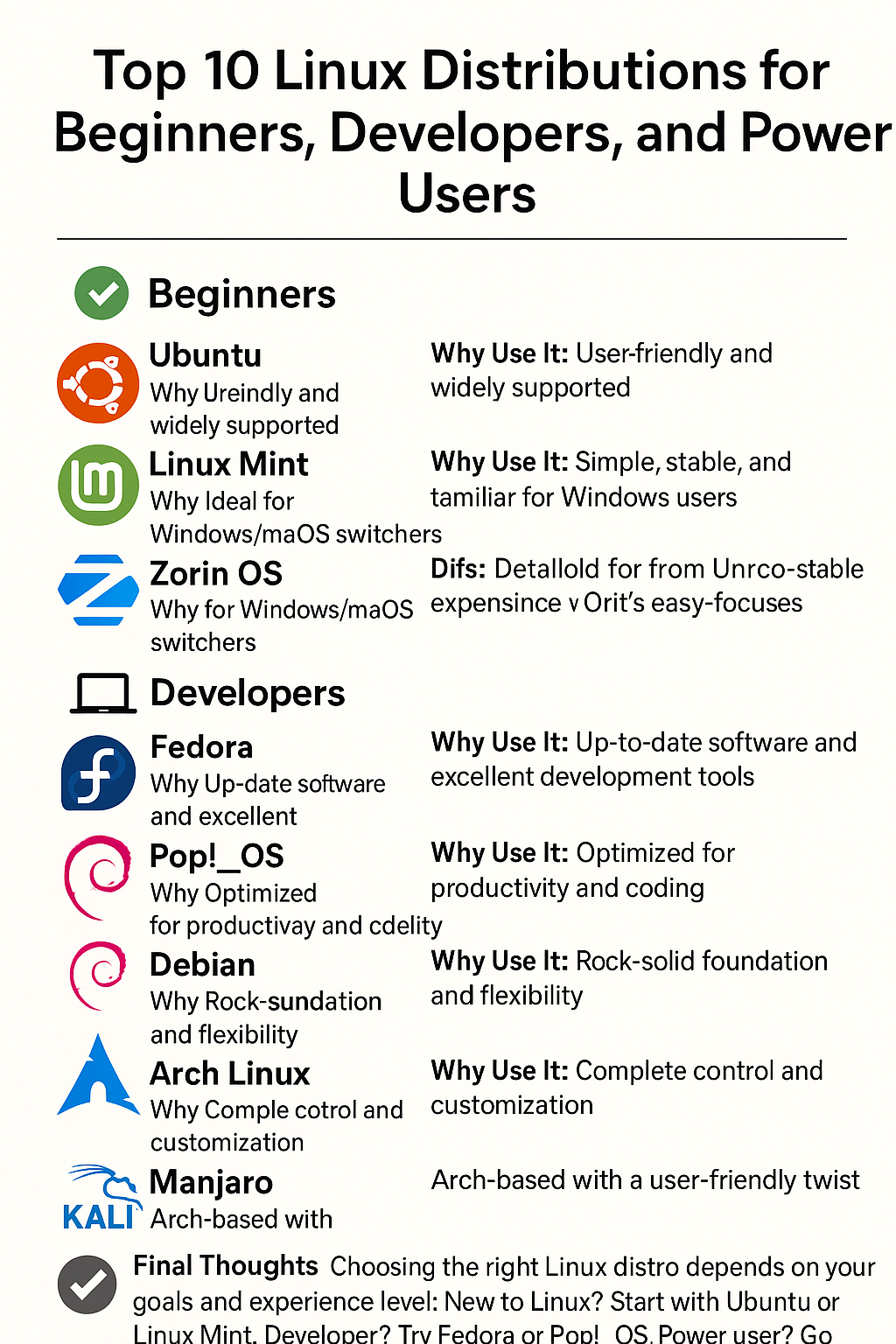
Unlike proprietary operating systems such as Microsoft Windows or Apple macOS, Linux offers users complete control over their computing environment. This control makes it particularly popular among developers, system administrators, and cybersecurity professionals. With distributions (or “distros”) like Ubuntu, Fedora, Debian, and Arch Linux, users can select a version that best meets their needs—from beginner-friendly interfaces to minimal, customizable environments for power users. In short, Linux is not just a software platform; it’s a community and a philosophy grounded in freedom and transparency.
A Brief History of Linux
The story of Linux began in 1991 with a 21-year-old Finnish student named Linus Torvalds. At the time, Torvalds was studying computer science at the University of Helsinki and using an educational version of the Unix operating system called MINIX. Frustrated by its limitations and licensing restrictions, Torvalds began developing a new kernel from scratch as a personal project. On August 25, 1991, he famously posted on the comp.os.minix Usenet group, announcing his work and inviting others to contribute.
What happened next was unprecedented. Developers around the world began contributing code, bug reports, and suggestions, turning a simple project into a global movement. By combining the Linux kernel with components from the GNU Project (a free software initiative started by Richard Stallman), users gained access to a full operating system known as GNU/Linux. Over time, Linux grew rapidly as more tools, compilers, libraries, and graphical interfaces were developed, forming complete distributions.
Today, the Linux kernel is one of the largest collaborative software projects in history. It is maintained by thousands of developers from around the world, including engineers from major tech companies such as IBM, Intel, Red Hat, Google, and many others. The Linux Foundation, a nonprofit organization, now supports the continued growth of the ecosystem and provides resources to educate and expand the community.

How Linux Works and Why It’s Different
To understand Linux, it’s important to grasp how it functions at a fundamental level. The Linux operating system consists of several key components: the kernel, system libraries, system utilities, and user interfaces. The kernel, developed by Linus Torvalds and others, is the core of the OS. It manages the CPU, memory, peripheral devices, and system processes. Everything from handling system calls to managing input/output devices is done by the kernel.
On top of the kernel, system libraries provide basic functions for software applications, such as reading files or connecting to the network. System utilities are programs that perform common tasks, such as file copying, disk management, and network configuration. Finally, user interfaces—either command-line interfaces (CLI) or graphical user interfaces (GUI)—allow users to interact with the system.
What makes Linux particularly powerful is its modularity and customization. Users can swap out components, change the desktop environment, or even rebuild the kernel. Package managers like APT (used in Debian-based systems) or YUM/DNF (used in Red Hat-based systems) simplify the installation and updating of software.
Example:
sudo apt update
sudo apt install firefox
Linux also excels in performance and stability. Unlike some operating systems that may slow down or crash under heavy usage, Linux handles resource management efficiently. This makes it ideal for running servers, embedded systems, or performance-critical applications. Furthermore, the Linux CLI offers powerful tools such as grep, awk, sed, and cron for automation, scripting, and system administration.
Useful Commands:
grep ‘error’ logfile.txt # Find lines containing ‘error’
crontab -e # Edit scheduled jobs
ps aux | grep apache # Check running processes
The Rise of Linux in Modern Technology
Linux is no longer just a niche OS used by hobbyists and hackers. It is now a backbone of modern computing. Android, the world’s most widely used mobile operating system, is built on top of the Linux kernel. Most websites you visit daily are hosted on Linux-powered servers. Companies like Google, Amazon, Facebook, Netflix, and Twitter rely on Linux to manage their infrastructure.
In addition to powering the cloud, Linux dominates in the world of supercomputing. As of recent statistics, over 90% of the world’s top 500 supercomputers run on Linux due to its scalability, performance, and security. It is also heavily used in embedded systems—the tiny computers inside devices like routers, smart TVs, and IoT gadgets.
| Area | Linux Usage |
| Mobile Devices | Android OS (based on Linux) |
| Web Servers | Apache, NGINX on Linux |
| Cloud Computing | AWS, Google Cloud, Azure (majority of VMs run Linux) |
| Supercomputers | Over 90% of Top500 Supercomputers |
| IoT Devices | Routers, Smart TVs, Home Assistants |
| Software Development | Preferred environment for tools like Git, Docker, Kubernetes, Python, etc. |
Developers favor Linux for its tool-rich environment and scripting capabilities. Programming languages like Python, C, Java, Ruby, and Go are natively supported, and development tools such as Git, Docker, and Kubernetes were either born or thrive in the Linux ecosystem. It is also the preferred environment for DevOps and system automation due to its robust support for configuration management tools like Ansible, Puppet, and Chef.
Why Learn Linux?
Learning Linux can be transformative for your career and technical understanding. Whether you’re an aspiring software engineer, a system administrator, a cybersecurity analyst, or just a curious learner, Linux provides an ideal platform to deepen your knowledge. You learn how an OS functions from the inside out, and gain hands-on experience with real-world tools and environments.
Open-source Linux distributions allow anyone to experiment safely. Tools like VirtualBox or WSL (Windows Subsystem for Linux) let you run Linux on your current computer without affecting your main OS. Online communities like Stack Overflow, Reddit, and specialized Linux forums offer vast support and documentation, making the learning curve less intimidating.
For instance, a beginner might start with Ubuntu for its ease of use and large community. Over time, they may move to Arch Linux or Gentoo to understand system configuration and kernel compilation. This progression builds both confidence and competence.
Top Beginner-Friendly Distributions:
- Ubuntu – Most popular for beginners
- Linux Mint – User-friendly and great for transitioning from Windows
- Zorin OS – Beautiful and familiar interface for Windows users
- Elementary OS – Clean, macOS-like design
Conclusion
Linux is more than an operating system—it’s a philosophy of collaboration, openness, and shared learning. From humble beginnings as a personal project to its current status as the foundation of much of our digital world, Linux has grown thanks to the contributions of countless developers and enthusiasts. It continues to evolve, adapt, and inspire innovation across every sector of technology.
If you are looking to start your journey into computing, or want to enhance your technical toolkit, there is no better place to start than Linux. With its flexibility, transparency, and global community, Linux represents not just the past and present of computing, but also its future.