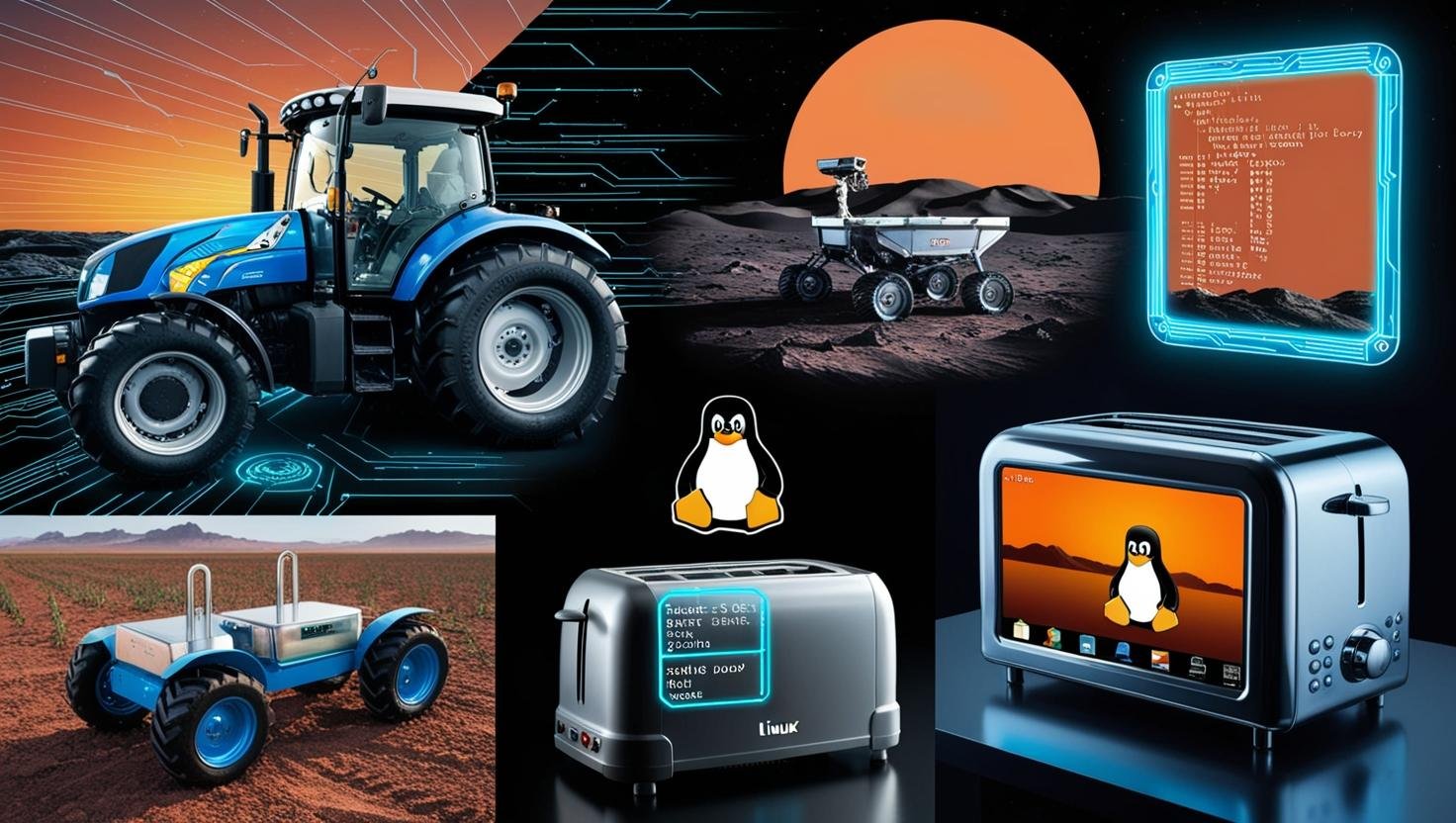
Linux on Unusual Hardware: From Toasters to Tractors
Linux on Unusual Hardware: From Toasters to Tractors
Linux, the open-source operating system that powers everything from smartphones to supercomputers, has found its way into some of the most unexpected places. While most people associate Linux with servers, developer workstations, or Raspberry Pi projects, its versatility has led to some truly bizarre and innovative implementations.
From hacked John Deere tractors running Kali Linux (thanks to the right-to-repair movement) to NASA rovers exploring Mars, Linux is proving that it can run on just about anything. In this article, we’ll explore some of the most unusual real-world uses of Linux, demonstrating just how flexible and powerful this OS really is.
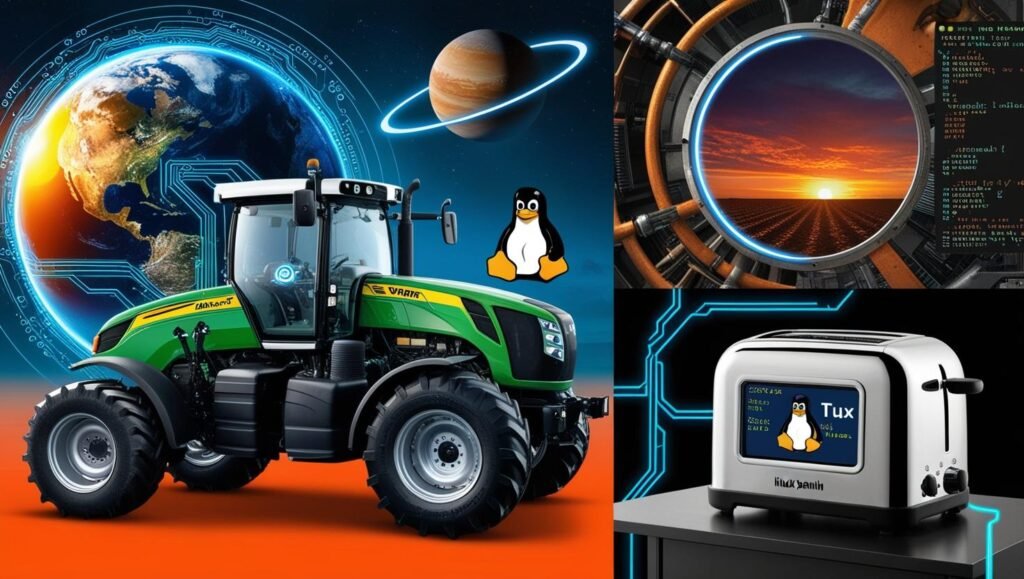
1. Linux on John Deere Tractors: The Right-to-Repair Revolution
The Problem: Locked-Down Farm Equipment
Modern farming relies heavily on advanced machinery, and John Deere has been at the forefront of agricultural technology. However, farmers have increasingly found themselves locked out of their own tractors due to proprietary software and DRM-like restrictions.
John Deere’s tractors are packed with sensors, GPS systems, and automated controls—all running on custom software. But when something breaks, farmers are often forced to pay dealerships for expensive repairs instead of fixing the machines themselves. This led to the rise of the right-to-repair movement, where farmers and hackers began modifying their tractors to regain control.
How Kali Linux Entered the Scene
Some tech-savvy farmers and hackers discovered that John Deere’s systems run on modified Linux kernels. To bypass the restrictions, they turned to Kali Linux, a penetration testing distro, to gain root access and modify the firmware.
By using tools like CAN bus analyzers and custom scripts, farmers have been able to:
- Disable software locks that prevent third-party repairs.
- Install open-source firmware for better customization.
- Access diagnostic tools without paying John Deere’s fees.
The Legal and Ethical Debate
John Deere has fought back, arguing that modifying tractor software violates copyright laws (under the Digital Millennium Copyright Act, DMCA). However, the US Copyright Office has granted exemptions for agricultural equipment, siding with farmers in the right-to-repair battle.
This case highlights how Linux’s open nature empowers users—even in industries dominated by corporate control.
2. Linux-Powered Smart Mirrors and E-Ink Tablets
Magic Mirrors: Linux as a Home Automation Hub
Smart mirrors, popularized by DIY tech enthusiasts, often run on Raspberry Pi with Linux. These mirrors display:
- Weather forecasts
- Calendar events
- News headlines
- Voice assistant integrations (like MyCroft or Alexa)
Projects like MagicMirror² (an open-source modular platform) allow users to build their own smart mirrors with minimal coding. Since Linux supports a wide range of displays and sensors, it’s the perfect OS for such custom gadgets.
E-Ink Tablets: Linux for Digital Note-Taking
Most e-ink devices (like Amazon’s Kindle) run proprietary software, but Linux has made its way into this space too. Devices like the:
- reMarkable 2 (running a Linux-based OS)
- PineNote (an open-source e-ink tablet)
These tablets are popular among writers, artists, and programmers who want a distraction-free, eye-friendly digital notebook. Linux allows for deep customization, enabling users to tweak everything from handwriting recognition algorithms to PDF rendering engines.
3. NASA’s Mars Rovers: Linux in Space
Perseverance and Ingenuity: Powered by Linux
When NASA’s Perseverance rover landed on Mars in 2021, it wasn’t just a triumph of engineering—it was also a win for Linux. The rover’s helicopter companion, Ingenuity, runs on a Linux-based flight control system.
Why Linux?
- Reliability: Linux’s stability is crucial in a mission where a crash could mean losing a $2.7 billion rover.
- Customizability: NASA engineers modified the kernel to handle Mars’ extreme conditions.
- Open-source tools: Many of NASA’s scientific instruments rely on Linux-compatible software.
Linux in Other Space Missions
NASA isn’t the only organization using Linux in space:
- SpaceX’s Dragon capsule runs on Linux.
- The International Space Station (ISS) has Linux machines for research.
This proves that Linux isn’t just for Earth-bound devices—it’s literally out of this world.
4. Even More Bizarre Linux Implementations
Linux in Toasters (Yes, Really)
In 2017, a developer created a Linux-powered toaster as a joke—but it worked. Using a Raspberry Pi, the toaster could:
- Adjust browning levels via a web interface.
- Print ASCII art of toast on an LCD screen.
While this was more of a fun experiment than a practical appliance, it shows that Linux can run on the most mundane devices.
Linux-Powered Tractors (Again, But Different)
Beyond John Deere, other agricultural machines are embracing Linux. Open-source tractor projects are emerging, allowing farmers to build fully customizable, repairable tractors without corporate restrictions.
Linux on E-Bikes and Scooters
Some electric bikes and scooters now use Linux for:
- Battery management
- GPS tracking
- Anti-theft systems
With open-source firmware, riders can tweak performance settings legally—unlike proprietary e-bike systems.
Conclusion: Linux’s Limitless Potential
From tractors fighting corporate control to NASA rovers on Mars, Linux continues to prove that it can run on anything. Its open-source nature makes it ideal for:
- Hackers and tinkerers who want full control over their devices.
- Scientists and engineers who need reliability in extreme conditions.
- DIY enthusiasts building smart mirrors, e-ink tablets, and even toasters.
As technology evolves, we’ll likely see Linux in even more unexpected places. Who knows? Maybe one day, your fridge, car, or coffee maker will be running a Linux kernel too.
What’s the weirdest device you’ve seen running Linux? Let us know in the comments!